
The Christ Meme
Resurrecting a Revolutionary Christ for the Regenerative Age

The Inheritance
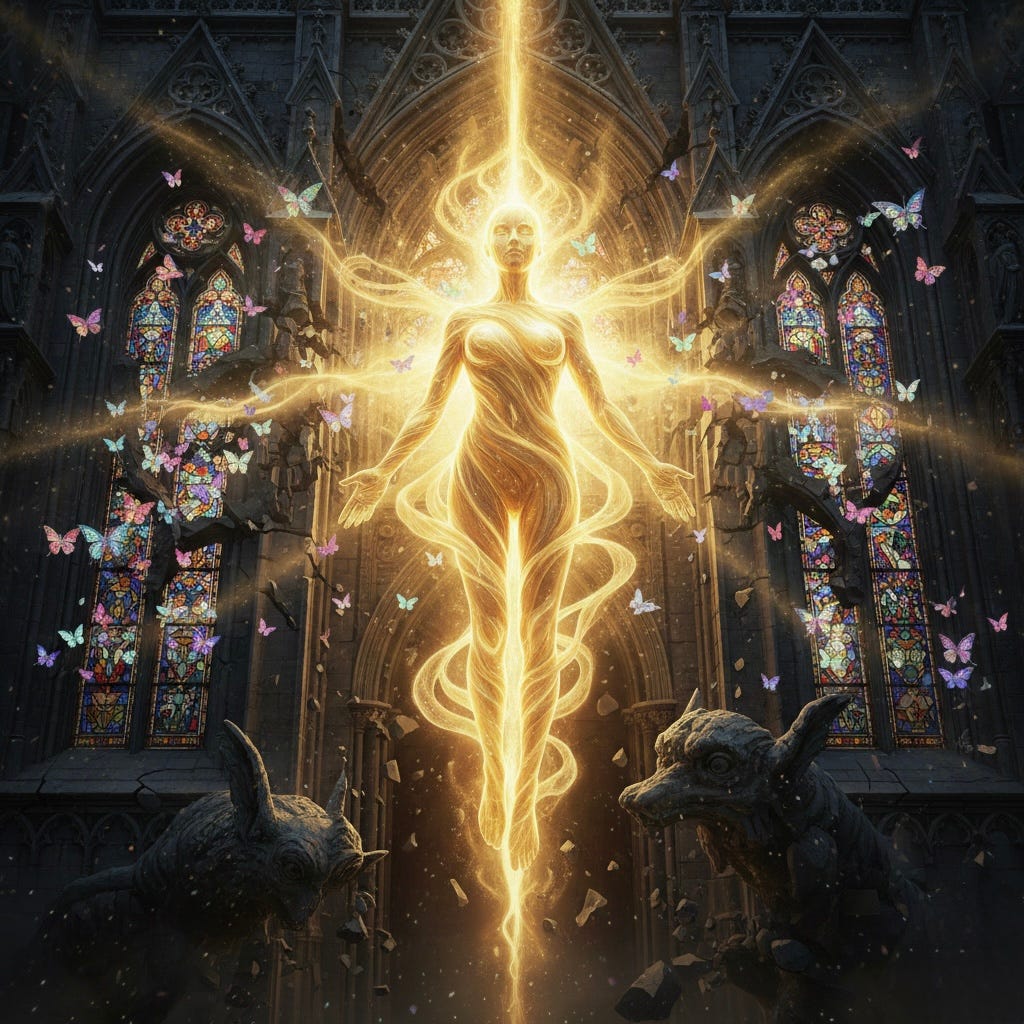
I was born inside the church. My father was an Episcopal priest, which meant I saw the institution from within: the vestments and the vestry meetings, the liturgical calendar and the parish politics, the genuine faith of congregants alongside the institutional machinery that contained it. I know the smell of the sanctuary, the banter of the Altar Guild, the bickering of Diosocean conventions, and the exhaustion of a clergy family during Holy Week, as the deepest memories of my childhood.
And I know what it feels like to leave.
For most of my teens and twenties, I couldn’t touch Christianity. The weight of its colonial legacy, the homophobia I witnessed in adjacent denominations, the way “Christian” had become synonymous with a particular American political pathology, all of it made the tradition feel not just irrelevant but actively harmful. I explored Buddhism, sat with indigenous teachers, read the Vedas, experimented with plant medicines. I was looking for something that Christianity, as I had inherited it, seemed incapable of providing: a spirituality that didn’t require me to submit to authority, that honored the earth, that made room for direct experience of the sacred.
What I discovered, after years of searching elsewhere, was that what I was looking for had been hidden inside what I’d fled. The poison contained the cure.
This essay is an attempt to articulate that discovery. Not as apologetics for the institutional church, which has much it must still answer for. Not as a conversion narrative designed to bring anyone back to Christianity as currently practiced. Rather, as an argument that the Christ meme, the symbolic and spiritual core of what Jesus actually taught, is not only recoverable from its colonial distortions but may be essential for the civilizational transformation that our moment demands. Resurrecting the Christ meme requires a deep and thorough accounting of the institutional Church’s role in the colonial project, one that New Age and metamodern Christians seem to have failed to address, making them as complicit in ongoing cultural genocide as the institutional Church leadership that preceded them.
The contents of this essay are heretical by the standards of both secular progressivism and orthodox Christianity. Progressives will object to rehabilitating anything associated with the Crusades, patriarchy, the Inquisition, and Native American boarding schools. Orthodox Christians will object to treating Christ as a “meme” at all, as if the Son of God were merely a useful idea rather than a metaphysical reality. I’m prepared to offend both camps, because I believe the stakes are too high for politeness.
On this Christmas of 2025, with democratic institutions crumbling and ecological systems destabilizing, with a raging loneliness epidemic and a scorched landscape of shared meaning, we need every tool available for rebuilding a world worth inhabiting. The Christ meme, if properly understood, is one of those tools. But to use it, we must first understand how it was broken.
The Apostle and the Emperor
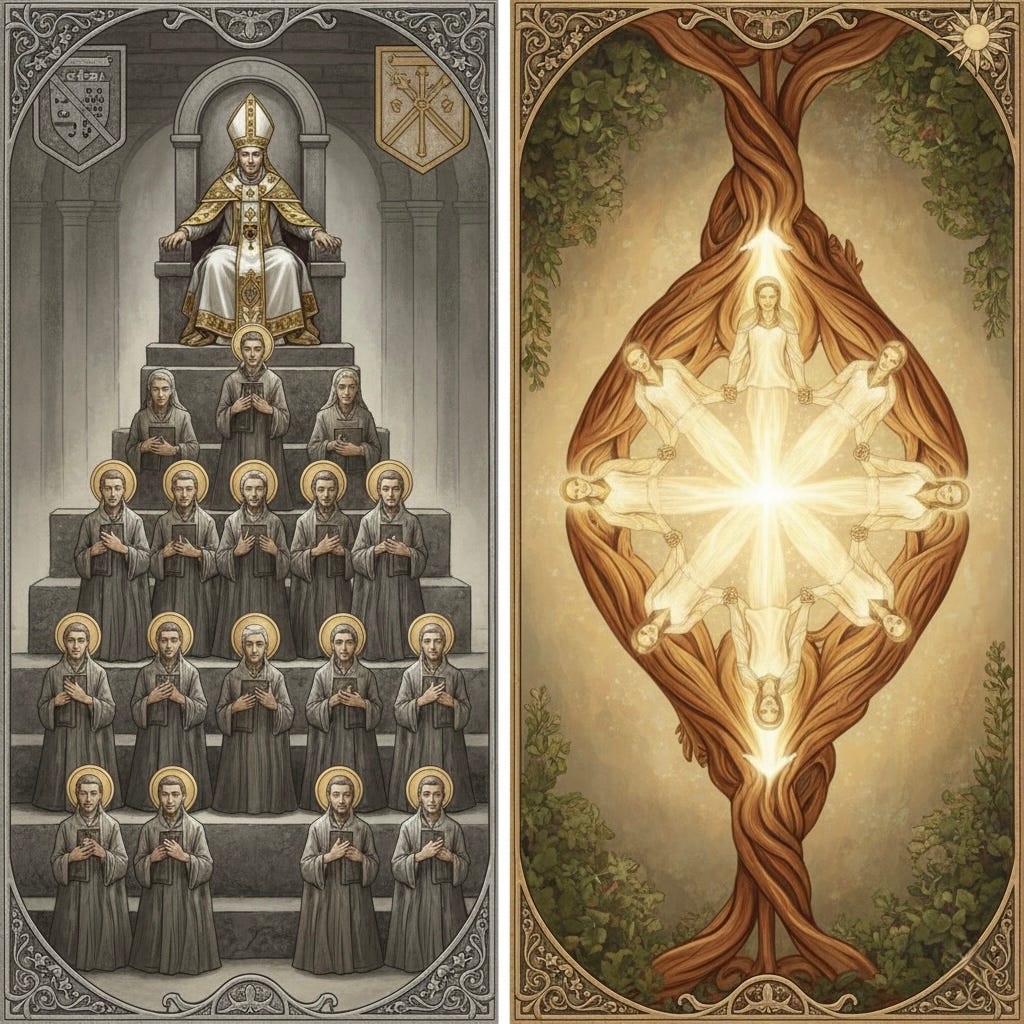
The transformation of Christianity from a radical Jewish sect into an imperial religion is one of history’s most consequential pivot points. Understanding it requires tracking two figures: Paul of Tarsus and Constantine I. Between them, they reshaped a teaching about liberation into a technology of control.
Paul never met Jesus during his ministry. His encounter was visionary, a light on the road to Damascus that converted him from persecutor to apostle. This matters because Paul’s Christianity was always, from its inception, an interpretation guided by evangelism rather than a direct transmission guided by original teachings. He was not passing along what he had witnessed but elaborating what he had experienced in revelation and then systematized through his formidable intellect.
Paul’s innovations were numerous and consequential. He removed the requirement of circumcision, making Christianity accessible to Gentiles without demanding they first become Jews. He developed the theological framework of salvation through faith in Christ rather than through works of the law. He created networks of churches across the Mediterranean, connected through letters that would later become scripture. He was, in the language of our time, a brilliant growth hacker, a marketing genius who understood that for an idea to spread, it had to be adapted to its audience.
But something crucial shifted in this adaptation. The earliest followers of Jesus understood their task as imitatio Christi, the imitation of Christ. They were to walk the path he walked, live as he lived, love as he loved. The goal was transformation: becoming Christ-like through practice and sacrifice. Jesus himself reportedly said that his followers would do works greater than his own, a statement that only makes sense if the point was to cultivate the same capacities he demonstrated, not merely to worship him from a distance.
Paul’s innovation was to make belief in Christ sufficient for salvation. Accept Jesus as your savior, and your sins are forgiven. This is a radically different proposition. It requires no personal transformation, no arduous practice, no dying to self. It requires only assent, a cognitive act rather than a developmental one.
This shift can be understood through the lens of memetic selection, a process analogous to natural selection but operating on ideas rather than genes. Just as genetic evolution favors traits that enhance reproductive success regardless of the organism’s wellbeing, memetic evolution favors ideas that spread effectively regardless of their truth or benefit to their hosts. The memes that survive and dominate are not necessarily the wisest or most liberating; they are the most transmissible.
Paul understood this intuitively. An idea that spreads through mere acceptance will always outcompete an idea that spreads through transformation, because transformation is hard and acceptance is easy. The version of Christianity that could spread fastest would spread farthest, regardless of whether it preserved the original teaching. This is not a moral judgment on Paul. He may have genuinely believed he was serving Christ’s mission. But the memetic logic is inexorable: virality and depth are at odds.
The second great transformation came at the Council of Nicaea in 325 CE, convened by Emperor Constantine to settle disputes that were fragmenting the Christian world. By this point, Christianity had grown from a persecuted sect to a significant political force, significant enough that Constantine saw value in unifying it under imperial patronage.
The Council produced the Nicene Creed, a statement of faith designed to establish orthodoxy and identify heresy. This was institutional enclosure in action: to create an inside, you must define an outside. The Creed specified what a Christian must believe: the Trinity, the divinity of Christ, the resurrection of the body, and implicitly designated as heretical anything that fell outside these bounds.
Just as significantly, the process that would culminate in a formalized biblical canon which determined which texts were scripture and which were not. Gospels that had circulated for centuries were excluded. The Gospel of Thomas, with its saying that “there are many paths to God, of which I am but one,” was rejected. The Gospel of Mary Magdalene, which positioned her as a primary apostle and spiritual teacher, was suppressed. The selection criteria were not purely theological; they were political. Texts that supported hierarchical authority, exclusive claims to truth, and the subordination of the feminine made the cut. Texts that didn’t were left to decay in the Egyptian desert, where some would be rediscovered sixteen centuries later.
Constantine’s personal conversion, legendarily prompted by a vision of the cross before a crucial battle, completed Christianity’s capture by empire. What had begun as a teaching that “the last shall be first” became the official religion of one of history’s most imperial societies. What had challenged “the powers and principalities” became their instrument.

The Doctrine that Discovered Nothing
The fusion of Christianity with empire was not a one-time event but an ongoing process that reached its fullest expression in the colonial era. The Doctrine of Discovery, promulgated through a series of papal bulls in the fifteenth century, gave Christian nations explicit permission to claim lands not ruled by Christian sovereigns, to convert (or eliminate) their inhabitants, and to extract their resources.
The theological logic was straightforward: if salvation comes only through Christ, and if salvation is the most important thing, then spreading Christianity is the highest possible good. Any means employed in service of this end—including conquest, enslavement, and genocide—could be justified as acts of compassion. We’re not stealing your land and killing your people; we’re saving your eternal souls. The cruelty is actually kindness, if you think about it correctly.
This is not an aberration or a corruption of Christianity. By the fifteenth century, it was a crystalized expression of the very imperial, institutional religion that had been shaped by Paul’s growth hacking and Constantine’s co-optation and a millennium of accumulated power. The Doctrine of Discovery was perfectly consistent with a faith that claimed exclusive access to God, that had subordinated the feminine, that had replaced transformative practice with doctrinal submission, and that had aligned itself with imperial power at every opportunity.
The accounting is almost too vast to comprehend. The Crusades. The Inquisition. The pogroms. The witch trials. The African slave trade, all of which were blessed by church authorities. The residential schools where indigenous children were stripped of their languages, their cultures, their families, all in the name of Christian civilization. The ongoing trauma in communities around the world where “missionary” remains a term of violation rather than service.
Anyone seeking to rehabilitate Christ must reckon with this history. Not as a regrettable sidebar but as the main text. The violence was not incidental to Christianity; it was structural. It flowed directly from theological choices made centuries earlier, choices that transformed a teaching of liberation into a tool of domination.
Pope Francis’s recent renunciation of the Doctrine of Discovery is a start, but only that. Institutional acknowledgment is not the same as institutional transformation. And the deeper question is whether the institution can be transformed at all, or whether the Christ meme must be recovered outside ecclesiastical structures entirely.
What Empire Had to Hide
The paradox at the heart of this history is this: the very features that made Christianity useful to empire were the features that contradicted Christ’s actual teaching. Empire didn’t adopt Christianity despite its radical message; empire adopted Christianity because that message had to be systematically suppressed in order for the imperial and colonial projects to succeed.
Consider what Jesus actually taught, as best we can reconstruct it from texts both canonical and suppressed:
Direct access to God. The teaching that we each have an unmediated connection to the divine, that no priest, no institution, no authority stands between us and the sacred, is fundamentally anti-hierarchical. If everyone has direct access to God, then religious authorities are at best helpful guides and at worst obstacles to authentic spirituality. Jesus’s confrontations with the Pharisees and Sadducees were precisely about this: the religious establishment had become a barrier to the relationship it was supposed to facilitate.
Fundamental equality. The teaching that every human being carries the same divine spark, that in the eyes of God, there is no Jew or Greek, slave or free, male or female, dissolves the legitimacy of every hierarchy. Not just religious hierarchy but political, economic, racial, and gender hierarchy as well. If we are all equally children of God, then any system that treats some as more valuable than others stands condemned.
Love as the supreme commandment. When asked to summarize the law, Jesus offered two instructions: love God, and love your neighbor as yourself. The second phrase is often heard as a moral injunction: be nice to people. But if read more carefully, Christ instructs us to love our neighbor as ourself. This is a statement about identity, not just ethics. Your neighbor is yourself, in a fundamental sense. Their flourishing is your flourishing. Their suffering is your suffering. This is interbeing, the recognition that we are not separate selves but nodes in an infinitely interconnected web of relationship.
The kingdom of heaven is within. Not in some distant afterlife. Not contingent on correct belief. Not mediated by institutional gatekeepers. Within. Already present. Waiting to be recognized.
These teachings are not just spiritually profound; they are politically explosive. You cannot build an empire on the premise that everyone is equal. You cannot maintain hierarchy if everyone has direct access to the source of authority. You cannot justify extraction if your neighbor’s suffering is your own suffering. You cannot control a population that has already found the kingdom of heaven within.
This is why the radical core of Christianity had to be neutralized. Not because it was weak but because it was dangerous. The teaching had to be inverted: direct access became mediated access through priests and sacraments. Fundamental equality became elaborate hierarchy. Love became compliance. The kingdom within became the kingdom after death, a promise of future reward that made present suffering bearable.
Original sin was the masterstroke. The doctrine that we are born fallen, broken, condemned, that our very nature is corrupt and in need of redemption, accomplishes several things simultaneously. It creates a problem that only the institution can solve. It generates the guilt and shame that make people easier to control. It severs us from the sense of innate wholeness that might otherwise lead us to question external authority. And it justifies whatever suffering the authorities impose, since we deserve it anyway.
But original sin is not the teaching of Jesus. It is the teaching of Augustine, developed centuries later. Jesus did not preach that we are fundamentally broken. He preached that we are fundamentally loved, and that recognizing this love transforms everything.
Hell as Protector Meme
To understand how imperial Christianity achieved such dominance, we need to examine its memetic architecture. Daniel Schmachtenberger has described how successful ideological systems develop what he calls “protector memes,” ideas that defend the memeplex from competition and ensure its propagation across every domain of human activity.
Hell is perhaps the most powerful protector meme ever devised.
Consider its function: if you believe that rejecting Christianity leads to eternal torment, not mere death, not temporary punishment, but infinite suffering, then the cost-benefit calculation of apostasy becomes impossible to justify. No matter how compelling an alternative worldview might be, no finite benefit can outweigh infinite cost. Hell makes it irrational to even seriously consider other paths.
But Hell does more than retain existing believers. It also motivates aggressive propagation. If you genuinely believe that non-Christians face eternal damnation, then converting them becomes an act of urgent compassion, the most loving thing you could possibly do. This logic sanctifies evangelism of every intensity, from gentle persuasion to forced conversion at swordpoint. After all, a few years of suffering in this life is nothing compared to an eternity of suffering in the next. Better to be colonized and saved than free and damned.
This is how a memeplex achieves total propagation, spreading through social pressure (everyone you know believes), political power (the state enforces religious conformity), economic incentive (advancement requires the right faith), cultural saturation (all art and education serve the message), and military conquest (conversion by force when other methods fail). Hell as protector meme enables Christianity to deploy all five vectors simultaneously, each reinforcing the others.
The genius is that this architecture is self-concealing. To those inside the memeplex, Hell is not a control mechanism but a simple fact about reality, as obvious as gravity, as certain as death. Questioning it feels not like intellectual liberation but like courting damnation. The prison is invisible to its inmates.
And yet Hell, like original sin, is not the teaching of Jesus. The elaborate medieval geography of eternal punishment, the circles, the demons, the lakes of fire, accreted over centuries, draws more from Dante than from the Gospels. Jesus spoke of Gehenna, a valley outside Jerusalem where trash was burned, as a metaphor for the destruction that follows a life lived in separation from God. This is not the same as infinite conscious torture administered by a loving deity. The doctrine of Hell as eternal torment is another imperial innovation: a memetic enforcement mechanism designed to prevent defection and motivate conquest.
Understanding Hell as a protector meme helps explain why imperial Christianity was so successful at propagating itself and why it was so destructive. A memeplex optimized for spread rather than truth will outcompete more accurate but less viral alternatives. It will capture institutions, shape cultures, and colonize minds across continents and centuries. It will also generate tremendous suffering, because its optimization target has nothing to do with human flourishing.
This is the memetic logic we inherited. This is what we must now consciously overcome.

The Blind God and the Ray of Light
The Gnostic Christians understood all of this. That’s why they were systematically exterminated.
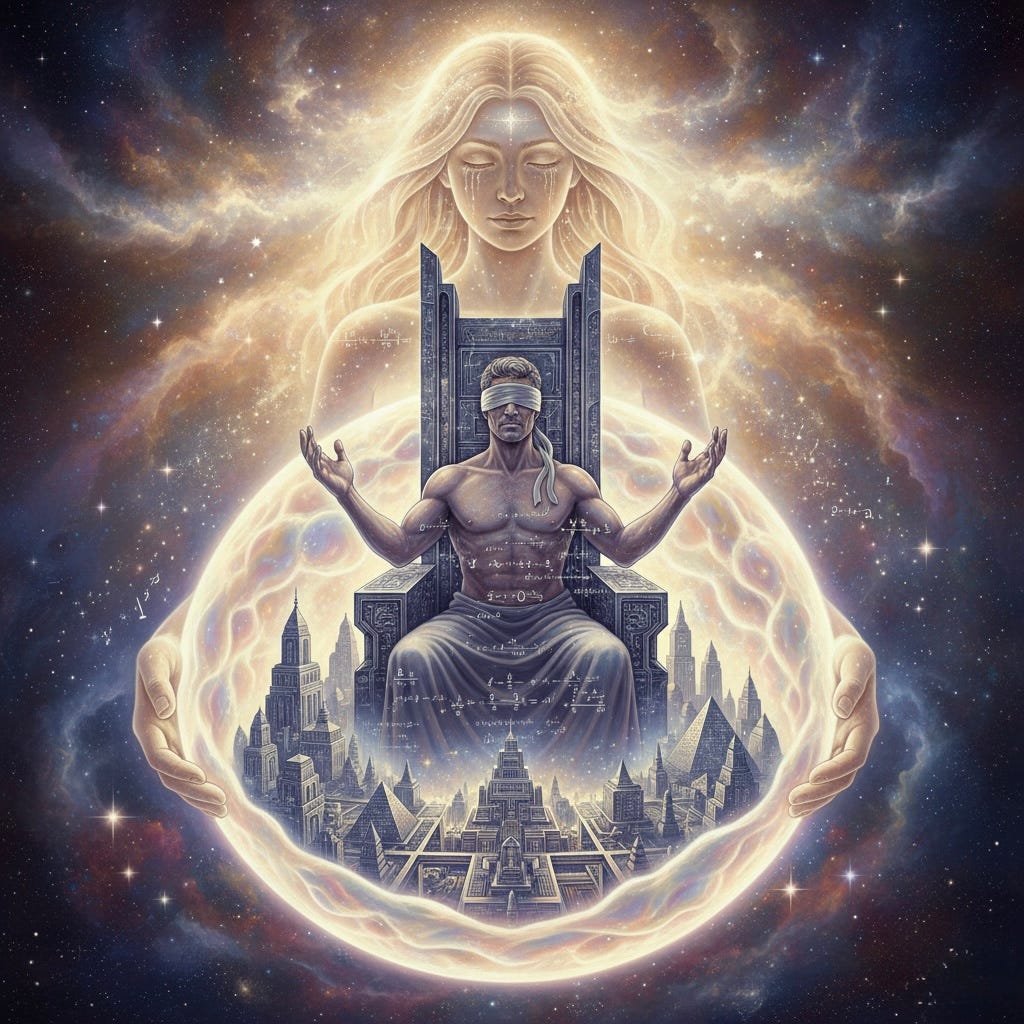
Gnosticism is a diverse tradition, but its core insight is that the god worshipped by conventional religion is not the true God but a lesser being, a demiurge who mistakes himself for the ultimate reality. In some Gnostic texts, this demiurge is called Yaldabaoth or Saklas, “the blind one.” He is not evil so much as ignorant: he doesn’t know that he himself was born from a greater source, that his apparent sovereignty is actually a small bubble within an infinite sea.
The Gnostic creation myth runs roughly like this: Sophia (Wisdom), an expression of the monad (divine oneness), lonely as the totality, sought to know herself and gazed upon her own reflection in the sea of chaos. In that moment of self-contemplation, she gave birth to the material universe and to the demiurge who rules it. But this universe is a realm of refractions, an image or reproduction of the divine totality from which it emanates. We are sparks of divine light embedded in matter, ruled by a god who doesn’t know he’s not God, subject to laws that have nothing to do with genuine divinity.
Into this prison, Sophia sends a ray of her own light: a messenger to remind the imprisoned sparks of their true nature. This is Christ, not a sacrifice to appease an angry deity but an awakener come to dissolve the illusion of separation. Christ’s message is not “submit to authority and you will be saved.” It is “you have never been separate from the source; you have only forgotten; remember who you are.”
This framework explains why the god of the Old Testament often seems so different from the God Jesus describes. The jealous, wrathful, tribal deity demanding blood sacrifice is the demiurge. The loving, non-dual wholeness from which all of creation is born is the true God, of whom the demiurge is an unconscious derivative. Christ comes not to fulfill the demiurge’s law but to supersede it, to replace hundreds of commandments with one: love.
The Gnostics were branded heretics and hunted across centuries. Their texts were burned; their communities were destroyed. And yet the teaching kept resurfacing, in the Cathars of medieval France, in certain strands of Christian mysticism, in the Templars and enlightenment alchemists, in the Nag Hammadi library buried in the Egyptian desert and recovered only in 1945. There seems to be something in human consciousness that, when it touches certain depths of non-duality, rediscovers these truths independently. Mystics across traditions report the same basic insight: that separation is an illusion, that we are expressions of one infinite consciousness, that what we seek we already are.
This is the esoteric teaching that empire could not afford to let spread. It is also the teaching most relevant to our current moment.
The Christos Sophia
There is one more dimension to the Gnostic understanding that demands our attention: the sacred union of masculine and feminine.
In the canonical texts, Mary Magdalene appears as a former prostitute whom Jesus healed, a repentant sinner, subordinate and grateful. But in the Gnostic gospels, she is something else entirely: a primary apostle, a spiritual teacher in her own right, and according to some traditions, Jesus’s equal partner and romantic consort.
The Gospel of Philip describes Jesus kissing Mary on the mouth, to the consternation of the male disciples. Other texts show her receiving teachings the others did not understand, engaging in theological debate with Peter, and being designated as the one who truly comprehends Jesus’s message. In the Gospel of Mary, she comforts the grieving disciples after the crucifixion and transmits esoteric teachings that Jesus shared with her alone.
Why does this matter?
Because the suppression of Mary Magdalene is not just misogyny, though it is certainly that. It is the suppression of an entire dimension of the teaching: the integration of masculine and feminine as the path to wholeness.
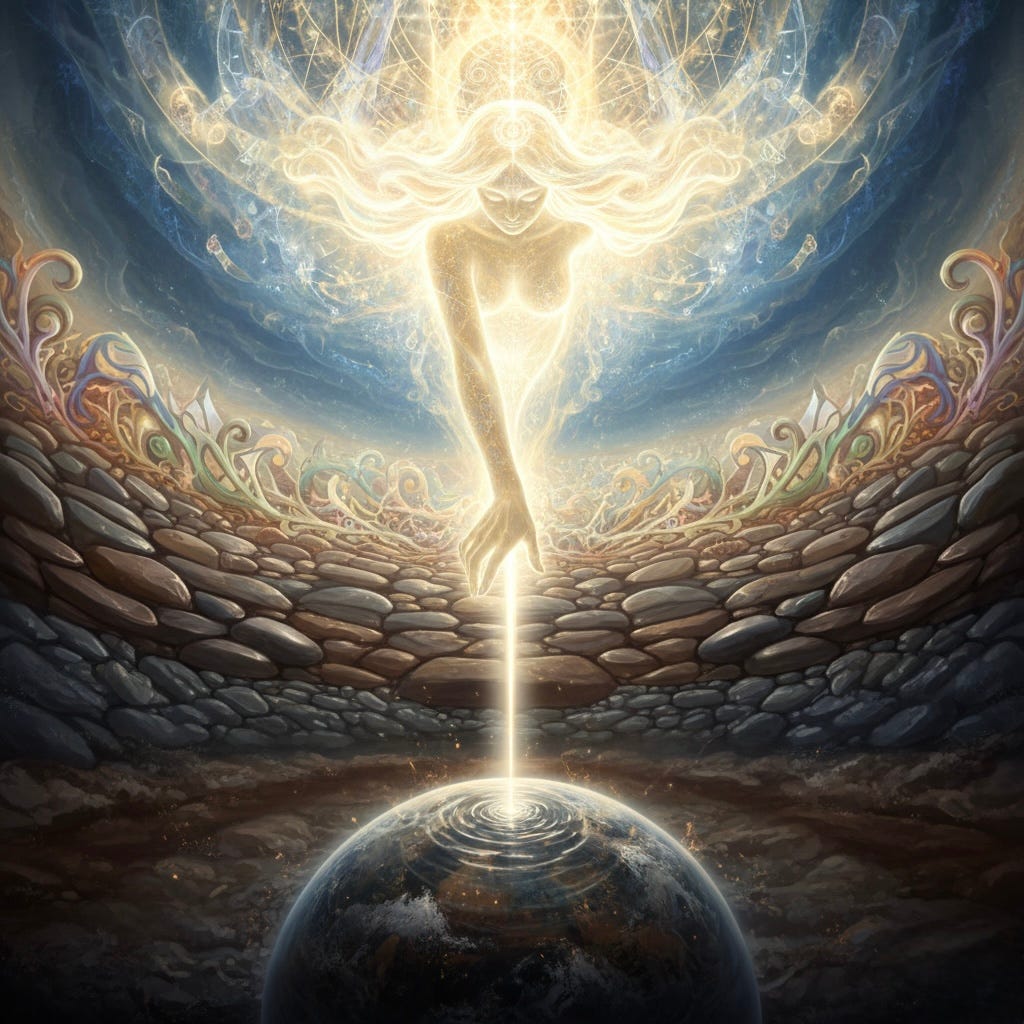
The Gnostic term is Christos Sophia: the union of Christ (the active, penetrating principle) and Sophia (the receptive, relational principle). Neither alone is complete. The masculine without the feminine becomes domination: will imposed without attunement, action without relationship, conquest without care. The feminine without the masculine becomes passivity: relationship without direction, receptivity without creative agency, care without capacity to protect.
True wholeness, what the alchemists called the coniunctio, is the marriage of these principles. It is the blade in service of the chalice: individual will aligned with the relational web of existence. It is the chalice offering direction to the blade: receptive wisdom guiding focused action.
Through the Christos Sophia, sexuality becomes sacred practice. When two beings merge in love, something of the original unity is recreated. The boundary between self and other dissolves; the illusion of separation temporarily lifts. This is why some traditions describe Jesus and Mary Magdalene as practitioners of sacred sexuality, perhaps trained in the temple traditions of Isis, where union was understood as a doorway to divine experience.
By suppressing Mary Magdalene, by casting her as a redeemed whore rather than an equal teacher, by making the godhead exclusively masculine, the imperial church accomplished several things. It subordinated women, obviously, creating theological justification for patriarchy. But it also removed from Christianity the very capacity for balance that could have prevented its worst excesses. A tradition with only the blade, only the penetrating, conquering, converting energy, will inevitably become violent. It has no internal principle of attunement, no capacity to ask whether its action is in right relationship with the whole.
This is why we have a civilization of rape and extraction. Not because of the teachings of Christ, but because the version of Christianity that dominated our cultural development was systematically stripped of the feminine intelligence that might have restrained the masculine drive to control. We have inherited a religion of the blade without the chalice, and we have built a world in its image.

The Second Coming
All of this brings us to the question of eschatology: What does it mean for Christ to return?
The conventional reading is straightforward: at some future moment, Jesus will literally descend from the sky, the dead will rise, and everyone will be judged according to whether they accepted him as their personal savior. The saved go to heaven; the damned go to hell. History ends.
But there is another reading, consistent with the esoteric traditions and with Jesus’s own words about the kingdom of heaven being at hand, being within, being here now:
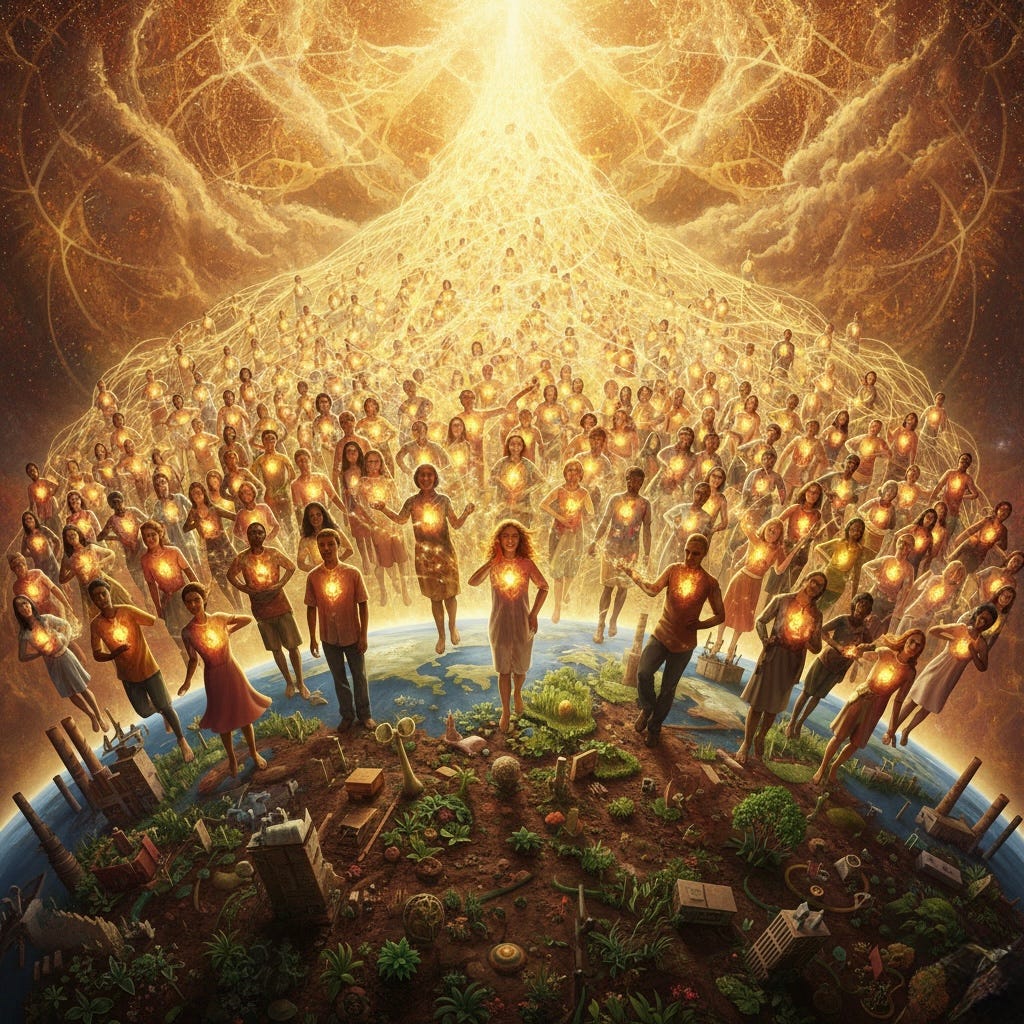
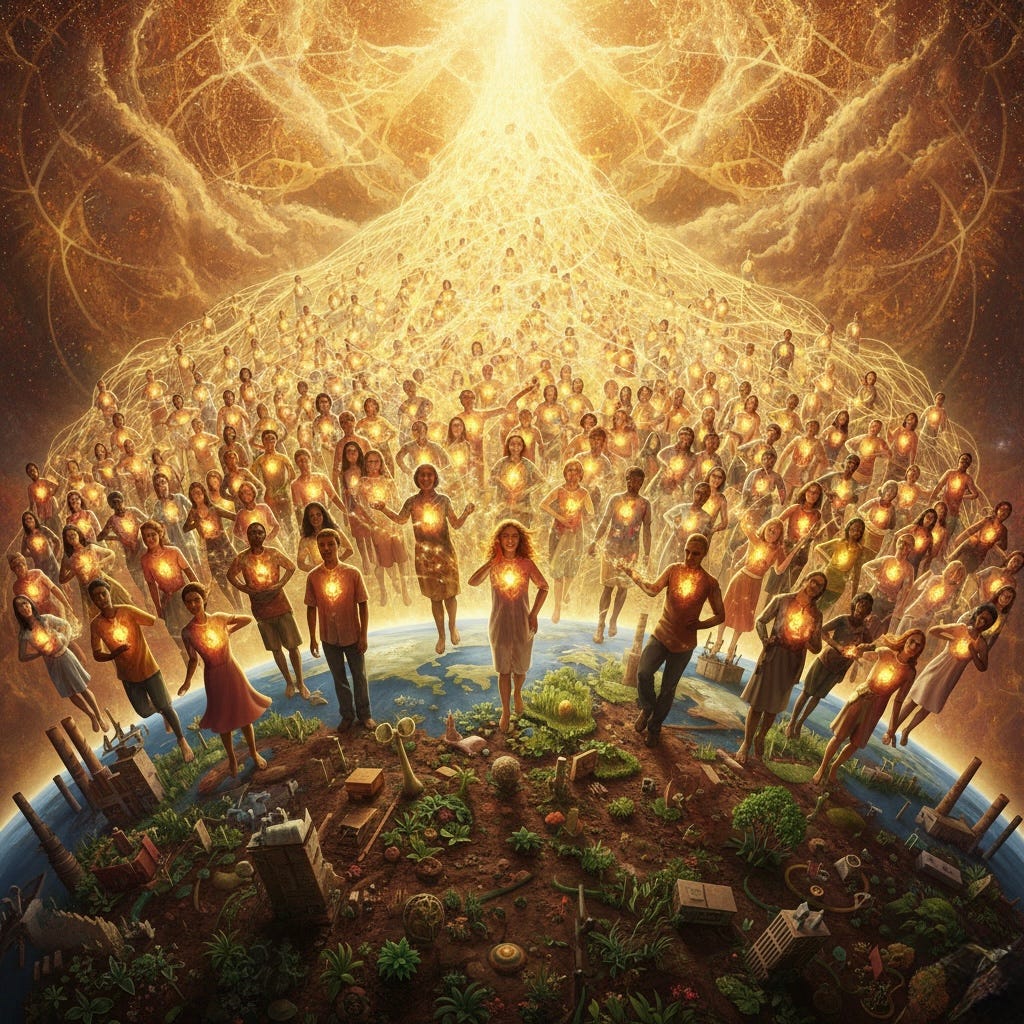
The second coming is not an event but an emergence. It is the awakening of Christ consciousness in human beings, the dawning recognition, in more and more of us, of our fundamental unity with each other and with the source of all being.
This is not a supernatural occurrence that happens to us. It is a developmental achievement that happens in us, through us, as us. Each person who genuinely realizes their interbeing with all existence, who loves their neighbor as themselves not as moral duty but as felt truth, participates in the second coming. Each community that organizes itself around mutual care rather than domination embodies the body of Christ.
Martin Luther King Jr. called this the “beloved community,” a society in which all people recognize their fundamental interdependence, in which justice and love are not opposed but identical, in which the transformation of hearts leads inevitably to the transformation of structures. King was not speaking metaphorically or sentimentally. He was describing a real possibility, grounded in a real understanding of human nature and divine reality.
The second coming, in this reading, is not the end of history but the beginning of a new phase of it. It is the moment when enough of humanity wakes up to our true nature that we can no longer sustain systems based on illusions of separation. It is the critical mass of consciousness that tips civilization from extraction and domination toward regeneration and interbeing.
This does not require everyone to become Christian in the institutional sense. The Christ meme, if properly understood, is not a tribal marker but a universal principle of God in matter, of wholeness realized through love. It is the recognition, available through many paths, that we are not separate, that love is the ground of being, that each of us carries divine light, and that our task is not to earn salvation but to express the wholeness we already are.
The Key and the Lock
I am not a Christian in any conventional sense. I practice Buddhism. I sit in ceremony and go on vision quest with indigenous teachers. I sing vedic chants and study process theology. I believe that ultimate reality exceeds any conceptual framework, including Christian ones, and that the appropriate response to the mystery is humility rather than certainty.
And yet I keep returning to Christ.
Not because the Christ meme is more true than other religious symbols. I don’t think religious symbols work that way. But because it may be more necessary for those of us shaped by colonial modernity.
Here is the logic: we have inherited a civilization built on separation. Separation of humans from nature, of mind from body, of self from other, of sacred from secular. This separation is not just an idea but an embodied reality. It lives in our nervous systems, our economic structures, our political institutions, our very sense of who we are. We are colonized at the level of consciousness.
Different medicines work for different conditions. What Buddhism offers, the dissolution of self, the recognition of emptiness, the release of attachment, is exactly what’s needed for a certain kind of suffering. But colonial consciousness has a specific structure, a structure that Buddha himself was not explicitly responding to, and that structure may require a specific key to unlock and heal.
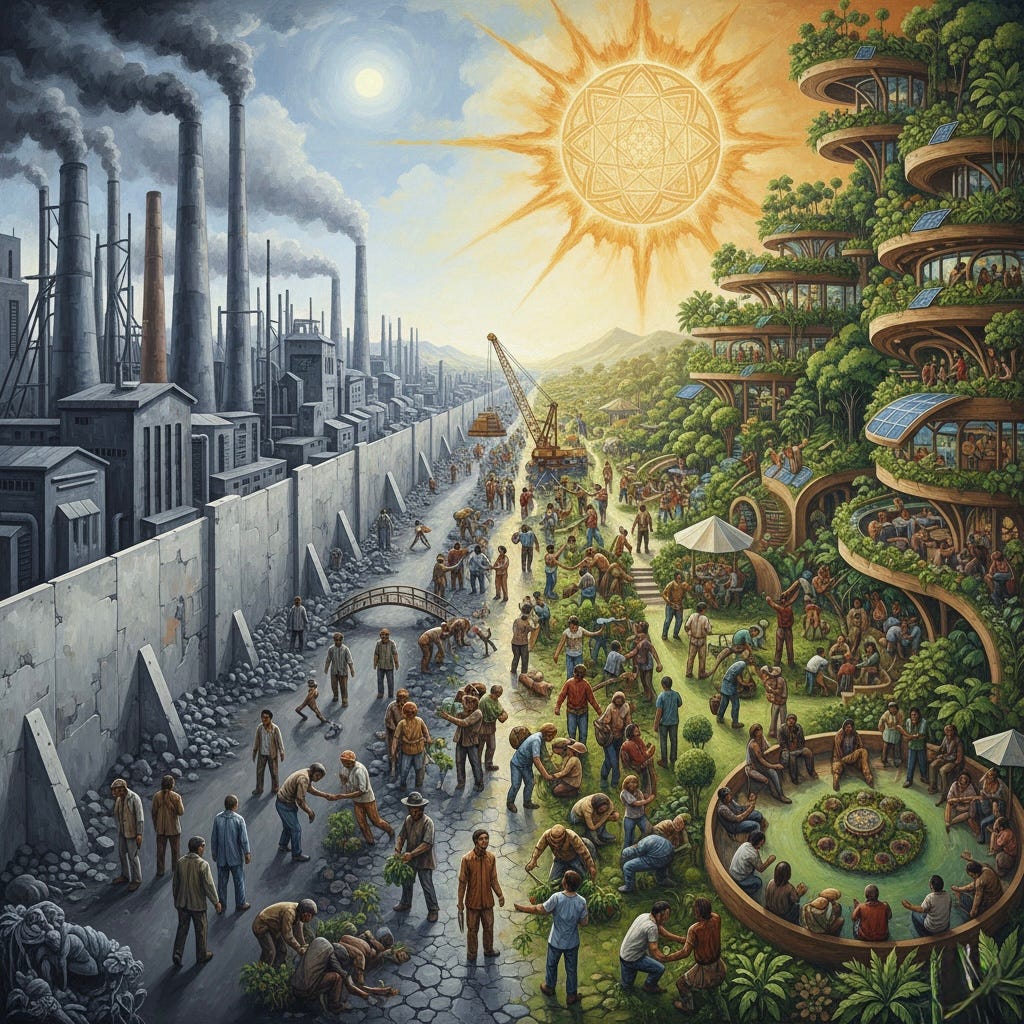
The Christ meme, resurrected through a non-dual or Gnostic remembrance, directly addresses the core wound of colonial consciousness. You believe you are fallen? You are beloved. You believe you are separate? You are one with all that is. You believe salvation comes through submission to external authority? The kingdom of heaven is within you. You believe the world is irredeemably broken? The world is the garden, and you are its steward.
The irony is that the very thing that wounded us, a distorted, Imperial, patriarchal, and colonial Christianity, contains within it the medicine for that wound. The poison and the cure are the same substance. This is not an accident. Empire captured Christianity precisely because Christianity was dangerous to empire. The revolutionary teaching was not destroyed but inverted, hidden in plain sight, waiting to be recovered.
This is why I believe resurrecting the Christ meme is not optional but necessary for those committed to regenerative civilization. Not because we need more Christians in the institutional sense, but because we need to reclaim the symbolic keys that unlock our particular prison. We need to complete the work that the Gnostics began, that the mystics continued, that Martin Luther King Jr and Cornell West and liberation theologians carry forward: the recovery of a revolutionary Christ from the imperial Christianity that entombed him.
The Urgency of Interbeing
What makes this recovery urgent is not abstract theological concern but concrete civilizational crisis.
The worldview of separation, the operating system installed by imperial Christianity and extended by colonial modernity, is now generating consequences that threaten the continuity of life on Earth. Climate destabilization, biodiversity collapse, nuclear proliferation, artificial intelligence racing ahead of wisdom, social fabric fraying into alienation and rage: these are not separate problems but expressions of a single underlying error. They are what happens when a species capable of planetary-scale impact operates from the premise that it is separate from what it impacts.
The logic of separation leads inexorably to extraction, because if I am separate from you and from the living world, then your flourishing has no intrinsic connection to mine. I can take from you and from the Earth without experiencing that taking as self-harm. I can optimize for my short-term benefit while externalizing costs onto others, onto the future, onto species that cannot advocate for themselves. This is rational behavior within the frame of separation and it is suicidal behavior when measured against the reality of interbeing.
We are running out of time for this error to correct itself gradually. The feedback loops are accelerating. The tipping points are approaching or already passed. The memetic immune system of imperial Christianity, the Hell-protected memeplex that has defended separation consciousness for centuries, continues to propagate even as the world it built burns.
This is why we cannot simply wait for better ideas to outcompete worse ones through some neutral marketplace of memes. The protector memes are too strong; the institutional inertia too great; the timeline too short. We need active, intentional recovery of the teachings that were suppressed, not as academic exercise but as survival strategy.
The Christ meme matters here because of who we are and where we come from. Those of us shaped by Western civilization, whether we identify as Christian or not, whether we practice the faith or reject it, have been formed by imperial Christianity at levels deeper than conscious belief. The assumptions of separation, the guilt of original sin, the vertical hierarchy of salvation: these are not ideas we chose but water we swim in. They structure our institutions, our relationships, our inner lives.
You cannot simply delete this conditioning through intellectual rejection. Atheism is not liberation from Christianity; it is often Christianity with the supernatural elements removed and the guilt intact. Secular modernity is not an escape from the Christian worldview; it is that worldview stripped of its few remaining checks on exploitation.
What is required is not rejection but resurrection, the recovery of what was alive in the teaching before it was captured, inverted, and deployed as a means of control. Not Christianity as institution but Christ as symbol of what we actually are: not fallen but whole, not separate but interwoven, not in need of external salvation but already expressions of the love that sources all things.
Christmas Morning
I write this to you, dear reader, on Christmas Day 2025. Outside my window, the world is as troubled as it has ever been, maybe more. The systems that promised progress are failing. The stories that promised meaning have collapsed. People are lonely and frightened and angry, and much of that loneliness and fear and anger is being captured by forces that offer false belonging, false certainty, false enemies to hate.
The consequences of separation are no longer abstract or distant. They are here, now, accelerating. We do not have generations to gradually evolve toward wisdom. We have years, perhaps only years, to fundamentally reorient our civilization before the feedback loops foreclose the possibility of reorientation at all.
And yet.
Something is also being born. In the cracks of the failing systems, in the grief that opens hearts, in the desperation that forces reassessment, something is stirring. People are beginning to question the operating system they inherited. They are discovering, through experience rather than doctrine, the reality of interbeing. They are finding that what imperial Christianity threatened them with, Hell, damnation, separation from God, was always a lie, and that what it promised through submission, salvation, belonging, eternal life, was always already theirs.
The Christ meme is not the only key. But for those of us colonized by its distortion, which is to say, for nearly all of us shaped by Western modernity, it may be the key that fits our particular lock. It speaks directly to our specific wound. It transforms the very symbols of our imprisonment into instruments of our liberation. It does not ask us to become something other than what we are but to recognize what we have always been.
This is not a call to return to church, to accept Jesus as your personal savior, to adopt any particular theological framework. It is a call to recover the living teaching from the dead institution, to find the Christ that the Christians buried. It is a call to recognize that you are not fallen, not broken, not in need of anyone’s permission to access the sacred. It is a call to understand that your deepest nature is the nature of God itself, and that this understanding, not intellectual but felt, not believed but known, is what the historical Christ was pointing toward all along.
The second coming is not a man descending from the clouds. It is us, waking up. It is the light that was always there, finally recognized. It is the garden we never left, seen at last with clear eyes.
This is what Christ was always pointing toward. Not worship of a distant God but recognition of the God within. Not submission to authority but alignment with love. Not the afterlife but this life, transformed by the knowledge of what it actually is: fundamentally sacred and worthy of protection and stewardship.
We cannot afford to leave this key unused. The lock is civilizational collapse. The door opens onto the only future worth inhabiting. The urgency is absolute.
The key of the Christ meme has been hidden in plain sight beneath two thousand years of patriarchy, imperialism and colonization.
May we have the courage to recover it.
May we have the courage to turn it.
May we have the courage to step through the door.
Merry Christmas. Christ is risen. Now, may Christ rise within us all.
I appreciate the care and seriousness with which The Christ Meme seeks to recover what was lost beneath centuries of empire, coercion, and institutional distortion. I share the conviction that Christ was buried under Christendom—and that any honest retrieval must reckon with colonial violence, patriarchy, and the misuse of theology as a technology of control.
Where I part ways is not in the diagnosis, but in the remedy.
My lifelong work has been shaped by a journey not to replace Christ with a non-dual abstraction, but to live in fidelity to the living Christ as the ontological source of love, order, and communion. That distinction matters to me personally. My life has been shaped by direct encounters with Jesus Christ—experiences I did not seek and could not dismiss—and much of my work since then has been an attempt to translate that encounter into lived form through local resilience, relational economies, and durable community.
What more than forty years of community work has taught me—often the hard way—is that unity does not emerge by sidelining or transcending religious commitments, including my own. I had to confront and move beyond my own post- and anti-religious assumptions to hold communities together. Efforts to neutralize or abstract deeply held faith commitments consistently narrowed participation rather than expanded it. Shared life required humility, translation, and fidelity—not transcendence of belief. Those lessons form the practical heart of the work I now share with others who want to build a durable, inclusive community.
When Christ is reduced—however reverently—to a symbolic carrier of awakening or a tool for civilizational repair, something essential is lost: Christ’s irreducible reality as more than metaphor, psychology, or a culturally useful key.
For me, the task is not to dissolve Christ into a universalized spirituality, but to distinguish Christ from empire without dissolving Christ into abstraction. The incarnation is not a dispensable layer over a deeper non-dual truth; it is the shock at the center of the Christian claim—that love is not merely a principle we awaken to, but a reality that meets us, calls us, and invites us into communion.
I’ve also noticed a broader pattern worth naming. Within “metamodern” Christianity, there is a recurring impulse to construct a post-Christian or meta-Christian version of the faith in order to remain intelligible or therapeutically effective. I understand the motivation. But this move quietly creates a new metaphysical bubble—new boundaries, new insiders and outsiders—and risks reproducing the very separation it hopes to heal.
There is a civic consequence here that matters. You write that you’re prepared to offend both camps because the stakes are too high for politeness. I understand the urgency. But the real question for community-building is not whether people are offended—it’s whether potential allies are being drawn into shared work or excluded by metaphysical framing they cannot inhabit.
A post-Christian reinterpretation of Christ may feel expansive to some, but it stands in tension with what most Christians actually believe and, in practice, narrows the space of shared meaning where cooperation becomes possible.
I want to be clear about my intent here. I want to see your work—and efforts like Open Civics—actually succeed beyond a narrow circle. My concern is that under the current metaphysical framing, that work risks being confined to a relatively small, self-selecting bubble. I’m naming this not as a critic, but as someone who cares about its civic potential and is reaching out as a brother who wants to see it flourish in the widest possible community.
I don’t believe Christianity must be abandoned to heal the wounds it helped create. Nor do I believe it can be redeemed by stripping it of its metaphysical claims. What’s needed is retrieval rather than replacement: a return to Christ as living presence, not symbolic medicine—one who confronts empire precisely because he is not reducible to it, and who grounds regenerative culture not in self-remembering alone, but in received and practiced love.
That is the line I am trying to hold.
Have you ever read something so brilliant and insightful that it gives you both frustration that you didn’t write it and utter joy that someone did? This is it. 😂
Thank you! Keep writing. ❤️🙏