
After The Black Pill
Epstein and the Great Unraveling

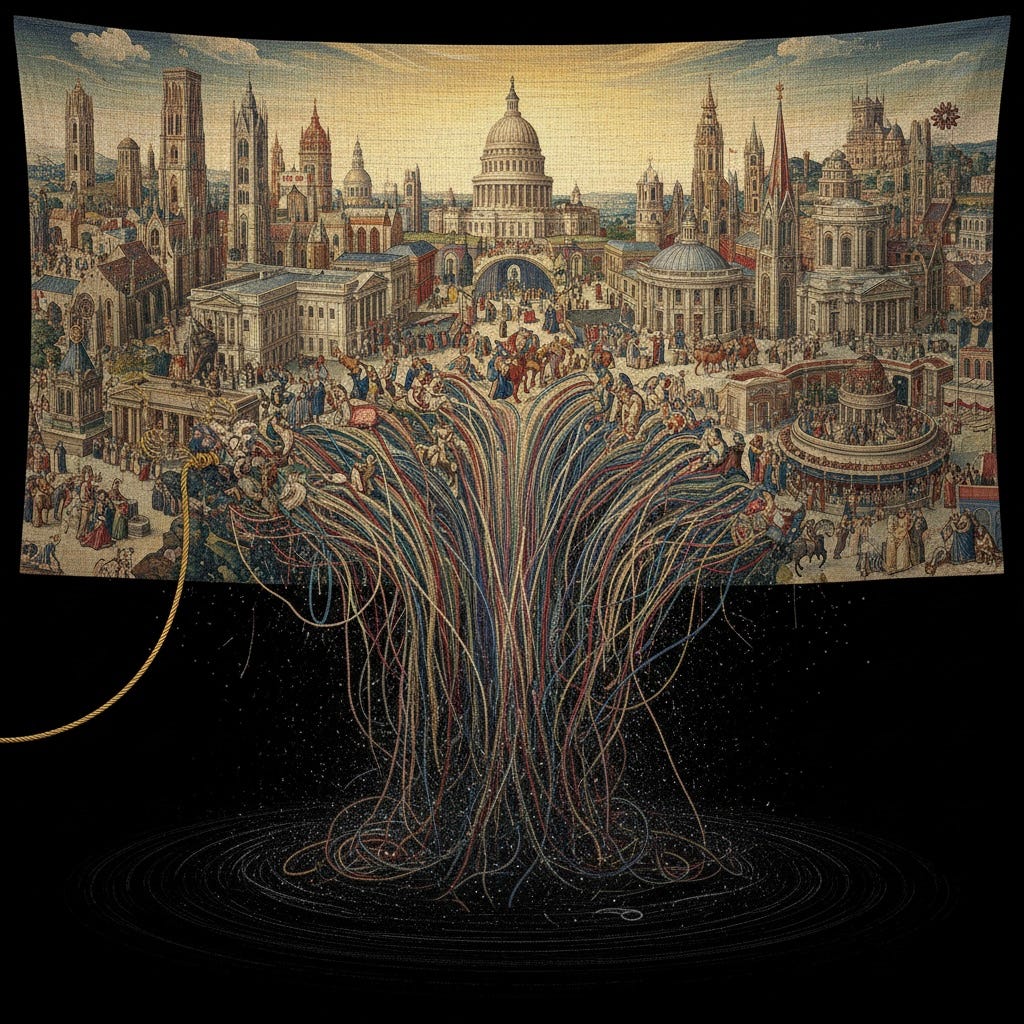
There is a particular quality of silence that descends when someone realizes they’ve been lied to about something fundamental. It is not the silence of confusion, nor of processing. It is the silence of the floor giving way, the extended moment of pause before the fall, when the body has not yet registered that there is no longer anything beneath it.
Millions of people are entering that silence now.
As the Epstein files are being released, heavily redacted and strategically curated as they are, they accomplish something that was never supposed to happen: they are making visible the shape of the cage.
We were told a story about the world. In this story, power flows upward through merit. Institutions, whatever their flaws, exist to serve the people who built them. The worst crimes are committed by deviants at the margins, caught and punished by systems designed to protect the innocent. The people at the top arrived there through some combination of talent and luck and determination, and while they may be flawed, while they may be greedy or vain or out of touch, they are still, fundamentally, people like us. Playing by recognizable rules. Constrained by laws and norms and the basic moral grammar that makes civilization possible.
The files show something different.
They show that at the highest levels of power, in the offices and islands and private planes where the trajectory of nations is shaped, a different set of rules applies. They show networks of complicity that span continents and decades. They show that the men who lecture us about justice and progress and the rule of law have participated in the most inhuman acts imaginable. They show that this behavior was not aberration but the price of entry into rooms where the real decisions are made.
They show, in short, that the story was a lie. Not a flawed story, not an incomplete story, but a deliberately constructed fiction designed to keep us looking in the wrong direction while the actual operations of power proceeded unobserved.
To reckon with what is being revealed requires more than updating a handful of beliefs. It requires the willingness to let an entire world collapse, a world in which things basically make sense, in which the institutions basically function, in which the worst possibilities are basically kept in check by the people whose job it is to check them.
That world is not real. It was never real.
What follows is an attempt to map the territory that becomes visible once the false map is released. It will not be comfortable. It will not resolve into a new story that restores the sense of coherence. But it may make possible something that false comfort never could: the capacity to act within reality as it actually is, rather than as we were told it would be.

The Layers of Unveiling
The first challenge is simply holding the complexity of what is occurring. We have been trained to sort information into binary categories: credible or conspiracy, mainstream or fringe, serious or paranoid, but the Epstein revelations refuse these familiar containers. They occupy a space our epistemological frameworks were not designed to accommodate: documented conspiracy at the highest levels of institutional power, reported by the same media apparatus that spent years assuring us such possibilities were beneath consideration.
As we fall through the looking glass, there are several lenses through which we must look simultaneously to get an accurate understanding of the landscape within which we’re embedded.
The first lens is what we might call the Great Unveiling: the simple, brutal confirmation of what was always true. Our leaders cannot be trusted. This is not the revelation of a secret so much as the documentation of a structure. The increasingly egregious and graphic materials recently released to the public may be new, but the underlying reality they evidence has been operating continuously for decades, shaping outcomes, constraining possibilities, determining who rises and who falls.
The hyperreality of late-stage capitalism has always required this particular kind of blindness. We are sold a narrative about the global order, that it operates according to a moral logic in which markets reward value creation, where wealth signals contribution, where the powerful are stewards of progress. This story has been so thoroughly institutionalized, in economics departments, in business schools, in the editorial pages of respected publications, in the very grammar of how we discuss success and failure, that questioning it marks one as naive at best, dangerous at worst.
But the files show us the men behind the curtain. And they are not wise. They are not virtuous. They are not even, in any meaningful sense, competent at anything other than the accumulation and protection of power. They are participants in a network of exploitation so systematic and so thoroughly documented that its exposure should, by any reasonable standard, delegitimize every institution it touches.
And it touches nearly everything.
The connections radiate outward from Epstein like cracks in glass. Intelligence agencies, foreign and domestic. The financial architectures that shape global capital flows. The scientific and academic institutions that credential expertise and legitimate corporate power. The media organizations that determine what questions can be asked in polite company. The philanthropic foundations that launder reputation and purchase influence. The political structures of multiple nations.
Mystery remains around certain specifics. Was Epstein a Mossad asset? The evidence increasingly suggests yes: his recruitment patterns, his funding sources that seemed to materialize from nowhere, the nature of his operation, all point toward state intelligence involvement. If this assessment is accurate, the implications cascade with devastating force: a foreign intelligence service operated a sexual blackmail network that tortured and abused children in service of capturing presidents, princes, academics, and titans of finance, likely with the knowledge and cooperation of American intelligence agencies.
But even this framing, foreign versus domestic, one nation’s operation versus another’s, may be too clean. What the files suggest is something more disturbing than a single nation’s intelligence operation: a transnational network of mutual compromise that transcends any particular state’s control. An emergent structure that serves power itself, regardless of which flag it flies.
A Controlled Demolition
Here we encounter the second lens, the one that transforms how we relate to the revelations themselves, their context and larger implications. In a political and media landscape as fraught and corrupt as our own, we should expect that even the disclosure itself might be designed to strategically manipulate our response.
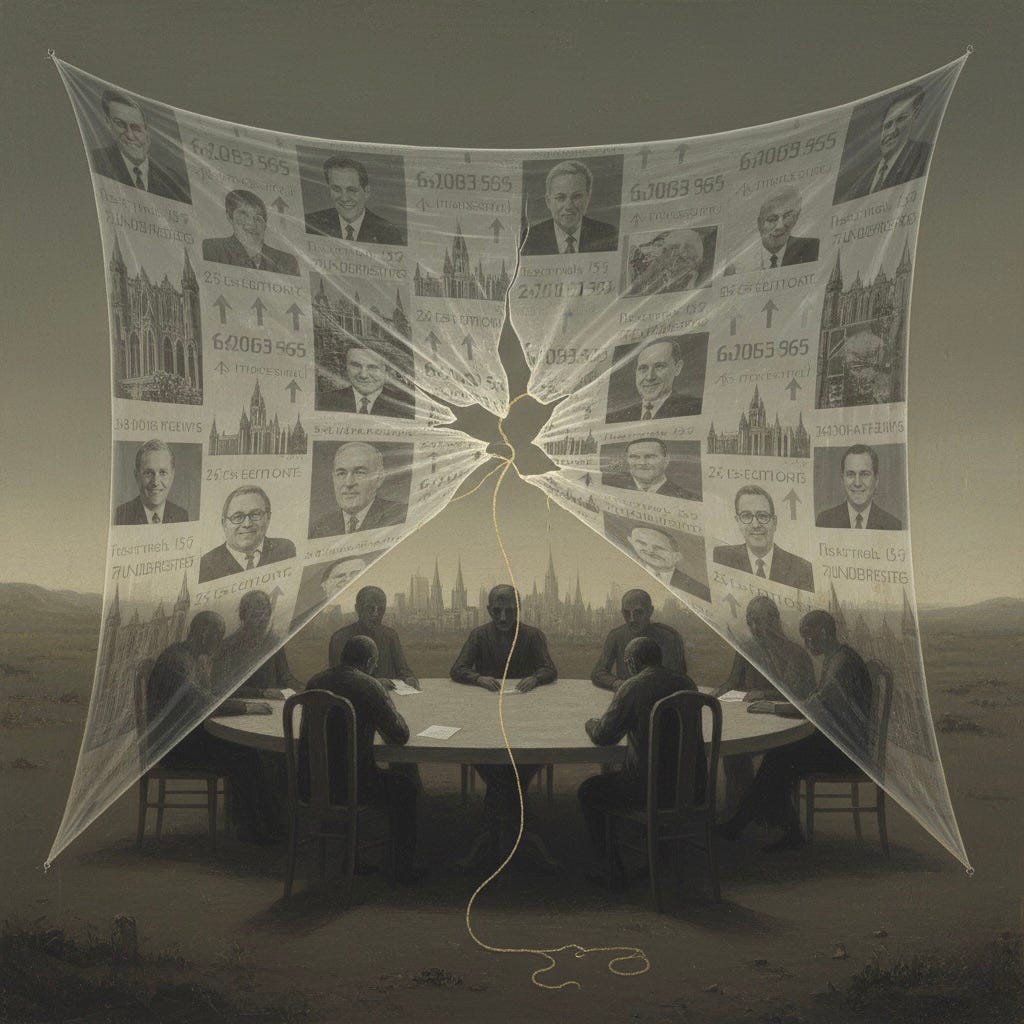
Intelligence agencies have developed sophisticated frameworks for handling compromised operations. When an operation has been blown, when denial is no longer tenable and information will inevitably reach the public, those responsible face a choice. They can stonewall completely, which risks uncontrolled disclosure as investigators pull at loose threads. Or they can get ahead of the narrative, releasing information themselves in a controlled manner, determining which facts emerge and which remain buried.
The latter strategy has a name: the limited hangout.
Understanding this explicit strategy of intelligence agencies changes how we interpret everything that follows. In a limited hangout, the agency acknowledges wrongdoing, but only specific wrongdoing. They sacrifice certain assets, individuals who can be framed as bad actors operating outside proper channels, while protecting the institutional structures that enabled them. They provide enough truth to satisfy the public appetite for revelation while containing the aspects of the operation that must remain hidden.
The goal is not transparency. The goal is narrative control through the strategic deployment of partial truth.
And so we must ask: whose interests are being served by how this information is being disclosed? Which names appear in the unredacted portions, and which remain behind black bars? Who decided what constitutes appropriate redaction? What criteria governed those decisions? Who established those criteria and how are they being enforced?
Consider the timing. Consider which outlets receive early access, which framings get amplified, which angles get memory-holed within the first news cycle. The choreography of disclosure is itself a form of information warfare. We are watching a controlled demolition and being asked to believe it is a natural collapse.
This is not paranoia. This is simply understanding how power protects itself. The same institutional apparatus that enabled the operation: the intelligence services, the prosecutorial offices, the political structures, now manages its exposure. They have every incentive to shape the narrative, to direct public attention toward certain figures while protecting others, to provide enough revelation to create the appearance of accountability while ensuring that the deeper architecture remains intact.
We are navigating not just the horror of what is being revealed, but the manipulation of how it is being revealed.
The floor is giving way, but someone is still trying to control where we land.

The Shattering of Ideology
Through all of this, something more fundamental is occurring than the exposure of specific crimes. The mythological structures through which Americans have understood their political reality: left and right, liberal and conservative, are breaking down simultaneously.
This synchronous collapse may be the most significant feature of the present moment. It forecloses the familiar moves by which people typically metabolize disturbing information. There is no safe ground to retreat to. No untainted narrative waiting to receive those who can no longer believe the previous one.
Consider first the liberal worldview that dominates college-educated Democrats. This orientation places its faith in institutions, in the integrity of bureaucratic processes, in expertise as the proper basis for authority, in what might be called the scientific management of civilization. The technocratic dream. International institutions represented the maturation of humanity beyond tribal nationalism. Professional norms would prevent the worst abuses. The adults, credentialed and vetted, were in charge.
Central to this worldview was a theory of legitimacy: the people in positions of power deserved to be there. Not because of inherited wealth or raw force, but because they had demonstrated competence, because they had been filtered through systems designed to elevate merit. The system had flaws, yes. But it was oriented toward progress. It was better than the alternatives. And it could be improved through proper channels by people who understood how it worked.
The Epstein files do not dent this worldview. They annihilate it.
The institutions that were supposed to embody expertise and integrity, the universities that hosted Epstein, that accepted his funding, that granted him access to their most promising students; the scientific foundations that legitimized his influence; the financial regulators who ignored obvious red flags; the intelligence agencies that ran or enabled his operation; the prosecutors who offered him an inexplicable plea deal, all stand exposed as compromised beyond any possibility of rehabilitation.
The experts were captured. The processes were penetrated. The guardians participated in the crimes they were charged with preventing. Every credential that was supposed to signal trustworthiness becomes, in this light, a mark of suspicion. The greater a person’s influence, the more likely they’re in on the con.
But this collapse of meaning is not confined to the liberal imagination.
The right-wing MAGA narrative is fracturing with equal violence, though this may be less immediately visible to those outside that spectrum of ideology. The entire Trump movement was constructed on a specific promise: that an outsider would storm the citadel, drain the swamp, expose the deep state, and hold the powerful accountable. Trump campaigned explicitly on releasing the Epstein files. He positioned himself as the instrument of popular vengeance against a corrupt elite.
But now we can see what was always in the files. Now that the veil has lifted, we can recognize that Trump knew the entire time just how embedded in the Epstein network he himself was. The photographs existed. The flight logs existed. The testimony existed. His own recorded comments, praising Epstein’s taste for young women, were public knowledge before his first campaign.
And yet he built his political brand on the promise of exposure.
The logic becomes clear only when you recognize the strategy: use the public’s legitimate desire for accountability as a vehicle to reach the one position from which disclosure could be managed. From the presidency, you can attempt to influence which files get released and which remain buried. You can attempt to ensure that any reckoning will be partial, selective, and protective of the networks in which you yourself are implicated.
This is not hypocrisy in the ordinary sense. It is something colder: a strategic calculation that the public’s hunger for justice could be converted into a means of its perpetual denial.
The MAGA faithful who believed Trump would deliver them from the pedophile elite must now confront an unbearable possibility: they were marks in a confidence game of historic proportions. Their righteous anger was harvested and redirected. Their genuine perception that something was deeply wrong was validated just enough to capture their loyalty, then channeled into a movement that would ensure the evil continued.
Both narratives have failed. Both camps have been played.
The music has stopped and there is nowhere left to stand.

The Silence After Stories End
So what remains possible? How does one proceed when every available narrative has collapsed? When neither the liberal faith in institutions nor the MAGA promise of heroic disruption retains any credibility?
This question concerns lessons gleaned from the deepest corners of the conspiracy rabbit hole, what the internet has named “the black pill.”
The black pill extends the Matrix metaphor into darker territory. Where the red pill represents awakening to uncomfortable truths and the blue pill represents comfortable illusion, the black pill names a specific kind of recognition: the system is not broken but functioning exactly as designed, just not for the purposes advertised. It is the moment of complete disillusionment, the surrender of any hope that existing structures might be reformed, that better actors might wield existing power more justly, that the machine might be turned toward humane ends if only the right people were operating it.
For many who arrive here, the response is paralysis or despair. The corruption seems so total, the capture so complete, that meaningful action appears impossible. What can one person do against a system that has anticipated every form of resistance, that has already captured every institution capable of mounting opposition?
Others develop a different pathology: fascination with the abyss. Cynicism becomes identity. The performance of worldly knowingness substitutes for genuine engagement. They collect evidence of corruption the way others collect stamps, not to do anything with it, but to confirm their sophisticated understanding that nothing can be done.
But there is another possibility, one that treats the black pill not as a destination but as a passage.
The shattering of illusions is not the end of the story. It is the precondition for something else to begin. What becomes possible after the black pill is a different relationship with reality, one no longer mediated by the comforting fictions that institutional actors have provided for our consumption. This is not comfortable. It is not reassuring. But it creates the possibility of response calibrated to actual conditions rather than fantasy.
The work that remains is integration: allowing ourselves to genuinely metabolize what is being revealed, to remap mental models that were shaped by decades of conditioning. This work will happen gradually and then all at once, as legitimacy itself collapses alongside financial and political systems. But ‘protector memes,’ concepts designed to keep you inside of a mental paradigm, remain.
The term “conspiracy theory” itself was created by intelligence agencies as an early experiment in social engineering. The term functions in our culture as an epistemological kill switch. It does not describe a type of reasoning; it designates a category of forbidden thought. Apply the label and the conversation ends. No engagement with evidence is required. One need not examine flight logs or testimony or financial records. One need only recognize that a claim has been placed in the forbidden category to know that taking it seriously would mark one as credulous, paranoid, unserious.
The genius of this framing is that it makes evidence irrelevant. The label does the cognitive work of dismissal before any facts can be considered.
The Epstein files demonstrate that some “conspiracy theories” were simply accurate descriptions of reality that arrived before their official documentation was released. The networks existed. The blackmail operations existed. The penetration of elite institutions existed. The only thing “theoretical” was the public’s access to proof.
This demands a reckoning not just with specific beliefs but with the entire architecture of credibility through which beliefs are formed. What else might be accurately described by claims we have been trained to dismiss? What other threads might unravel what other veils?

The Trap Within the Trap
Here, however, another danger awaits, one that has already captured millions of people and may itself be a product of the same intelligence apparatus that created the original disease.
If uncritical faith in institutions represents one failure mode, the alternative cannot simply be believing everything institutions deny. The QAnon phenomenon and the broader “conspirituality” culture that has emerged at the intersection of wellness and paranoia, these represent a different form of capture, another way of being led away from genuine understanding.
The epistemological error is symmetrical. Where the institutionalist accepts official sources without examination, the conspirituality adherent rejects them without examination. Both positions outsource discernment. Both avoid the actual work of evaluating evidence and arguments on their merits. Both are, in their different ways, cognitively lazy, which is to say easily exploitable, and both have been exploited.
It is entirely possible that movements like QAnon were themselves products of intelligence operations. Not because the crimes they reference are fictional, the files confirm many of those crimes were terribly real, but precisely because they are real. If you know that damaging information will eventually surface, one strategy is to pre-contaminate it. Mix accurate intelligence about elite networks with flat earth theory and antisemitic blood libel. Embed genuine revelation in a context so absurd that reasonable people will dismiss the whole package.
This is more sophisticated than denial. It exploits pattern-matching and tribal identification. Those who adopt the QAnon framework become marked as cranks, their legitimate concerns buried beneath associated nonsense. Those who reject QAnon feel justified in dismissing everything adjacent to it, including documented crimes that were always the kernel of truth around which the disinformation was constructed.
The person who rejected “conspiracy theories” reflexively was manipulated into complacency. The person who embraced QAnon uncritically was manipulated into discreditation.
Both responses were anticipated. Both were designed.
This is the sophistication we are up against: an information environment in which every apparent escape route has been mapped and every exit leads back into the maze. The only way out is through, through the careful, painstaking work of holding complexity without collapsing, tolerating the discomfort of genuine uncertainty.
The Ontological Threshold
But something is shifting nonetheless.
Figures like Representative Thomas Massie, elected officials with institutional positions and access to classified materials, are publicly naming what was previously unspeakable. The frame of “conspiracy theory” loses its power when sitting members of Congress confirm essential claims. The protector memes fails when ideas escape into mainstream discourse through channels that cannot be dismissed as fringe.
This migration from margin to center creates new demands. It is one thing to dismiss claims made by anonymous accounts on obscure platforms. It is another to process those same claims when they appear in congressional testimony, in court documents, in the statements of officials who have examined the evidence directly.
What is required now is nothing less than a genuine ontological shift, a reorganization not merely of what facts one accepts but of the underlying model of how reality operates.
This is why the transition is so difficult. It destabilizes identity itself.
Most people have constructed their understanding of the world, their sense of their own position within it, their relationships with others and with institutions, around assumptions that the Epstein revelations directly contradict. The liberal professional who built a career within institutions now revealed as compromised faces not just new information but existential threat. Their competence, their judgment, their very identity as someone who understands how things work, all are called into question. The conservative who believed Trump would deliver accountability must confront the possibility that their discernment failed catastrophically, that they were played by someone who saw them as marks.
Most people, across the spectrum, maintain some residual faith that at least part of their side’s leadership is legitimate. Perhaps with sophisticated caveats: systems are complex, there are competing factions, not everyone is corrupt. But beneath these qualifications lies a baseline assumption: the institutions can be made to work, they are ultimately oriented toward what they claim to serve.
The black pill means surrendering this assumption entirely.
It means acknowledging that the systems we have inhabited are not flawed but structurally oriented toward outcomes antithetical to human flourishing. That the people at the apex are not outliers but the perfected products of a selection process that reliably elevates exactly what they embody.

The Machine and Its Intent
“Purposes are deduced from behaviour, not from rhetoric or stated goals.”
– Donella Meadows
As Donella Meadows noted in her book Thinking in Systems, the purpose of a system is what it does. This is the insight that transforms our understanding of Epstein’s network from an aberration within an otherwise functional system to the logical output of a system optimizing for particular values. These values and the incentives that produced them, pursued to their endpoint, necessarily produce exactly what we are now seeing.
Consider the evolutionary dynamics at work.
A system that rewards extraction over regeneration, competition over cooperation, short-term gain over long-term flourishing, will differentially select for individuals capable of operating by those rules. Empathy becomes a competitive disadvantage. It creates hesitation, it generates inconvenient moral considerations, it slows down the ruthlessness required to win. Conscience becomes friction. The willingness to do whatever is necessary, without moral pause, without squeamishness, without the drag coefficient of human feeling, becomes the supreme adaptive trait.
Run this selection process for decades. Concentrate wealth and power in fewer and fewer hands. Create institutions where advancement depends on demonstrating loyalty to those above you and extracting value from those below. Ensure that anyone who raises ethical objections is filtered out long before they reach positions of real influence.
The individuals who eventually arrive at the apex will be those most thoroughly optimized for the system’s actual values. Not the stated values: service, stewardship, responsibility, but the operational values: extraction, domination, the accumulation of leverage without limit.
That such individuals would engage in the exploitation of children is not surprising once you understand the logic. It is, in a terrible way, predictable. They are doing what the system shaped them to do: treating human beings as resources, including the most vulnerable human beings, those least capable of resistance.
But there is a deeper dimension here, one that illuminates not just individual pathology but the civilizational pathology that makes it possible.
Consider the challenge faced by a network of sociopathic narcissists attempting to maintain coherent action over time.
Genuine sociopathy and narcissism, the clinical absence of empathy, the inability to form authentic bonds, the orientation toward others purely as objects to be manipulated, creates a specific coordination problem at scale. How do you maintain alignment among people who cannot be trusted? Who would betray any alliance the moment it suited them? Who feel no loyalty, no guilt, no internal restraint?
The only reliable mechanism is mutually assured destruction.
If every member of the network possesses information about every other member, information so damaging that its release would mean complete ruin, then a stable equilibrium emerges. Not through trust, but through terror. You protect the network because the network can destroy you. Your interests align with collective interests not through genuine mutualism but through the logic of mutually held leverage.
Sexual blackmail serves this function with terrible efficiency. The abuse of children is the ultimate transgression, the one crime that no narrative can rehabilitate, no passage of time can diminish, no amount of wealth or power can spin into acceptability. Once you are documented participating in such abuse, you are owned. Permanently. Completely. Your fate is bound to everyone who shares your vulnerability.
This is not speculation about individual psychology. It is a structural analysis of how such networks must operate given the characteristics of their members. The blackmail is not incidental to the system. It is the mechanism that makes the system possible, the dark binding that creates coordination among those incapable of trust.
The perpetrators are not the disease. They are the symptom. They did not conspire to create this structure. The structure emerged because it was the only configuration stable enough to contain their relentless self-interest.

A Different Story of Power
At its core, this structure is a tangible expression of how power flows among people who cannot access the capacities for human relationship.
People who intentionally develop their capacity for empathy, who can feel the reality of others, who experience self-aware conscience, who form authentic bonds, can coordinate through entirely different means. They coordinate through genuine relationship, through shared meaning, through the fact that they care about each other and about outcomes beyond personal advantage. They can trust because they can perceive trustworthiness. They cooperate because cooperation is both strategically and intrinsically valuable.
The sociopathic network cannot access these capacities. It can simulate them: deploy the appearance of warmth, perform the gestures of friendship, but the simulation is always instrumental, always in service of positioning. Because it cannot generate genuine trust, it must substitute coercion. Because it cannot rely on authentic alignment, it must manufacture alignment through leverage.
This reveals something crucial about the limits of such systems.
The blackmail network operates entirely within transactional logic. It models human beings as objects to be manipulated, relationships as leverage to be accumulated, trust as a resource to be exploited. This is fundamental to how such systems perceive and process reality.
Genuine empathy cannot be simulated from within the transactional frame. It cannot be faked, because its authenticity is precisely what makes it functional. When human beings actually connect, when they experience each other as subjects rather than objects, when they engage in the vulnerable exchange of authentic presence, something becomes possible that no amount of strategic manipulation can replicate.
The blackmail network coordinates through mutual destruction. Authentic community coordinates through mutual care. These are not variations within a single framework. They are fundamentally different modes of organization, operating according to different logics, producing different outcomes.
The machine cannot perceive the register in which authentic coordination operates.
It cannot see us when we function in modes it has no concepts for.
The Thread Pulled
Jeffrey Epstein represents something specific in this architecture. He is not its designer but its exposure point, the thread that worked loose and caught the light.
Every complex system has vulnerabilities: nodes where the concealment fails, where coordination breaks down, where something slips through. Epstein’s particular combination of characteristics: his visibility, his apparent belief in his own invulnerability, his continued operation after his first prosecution, made him such a node. His arrest, his death under circumstances that strain credulity, the subsequent legal proceedings, the gradual release of documents, each development tugs at the thread and loosens more of the weave.
This is how networks unravel. They are resilient until they are not. They can absorb damage, sacrifice peripheral members, maintain coherence through selective pruning. But beyond a certain threshold, exposure becomes cascading. The mutual blackmail that held the network together becomes mutual visibility. The documentation that ensured loyalty finally delivers on its promise of mutually-assured destruction.
Keep pulling and the entire fabric becomes visible. The intelligence connections. The financial structures. The academic institutions. The media organizations. The ways in which every system we were taught to trust has been penetrated, the ways the whole apparatus has been corrupt not as deviation but as design.
The unraveling is underway. It cannot be fully stopped. The limited hangout manages it, the redactions protect critical nodes, but the veil’s integrity has been fundamentally compromised. No amount of strategic disclosure can repair it now.

The Invitation
What remains for those of us living through this unraveling is to allow it to occur within ourselves.
This means letting certain illusions die, not theoretically, not as intellectual positions to be revised, but as lived structures that have organized perception and identity. The death of an illusion is experienced as loss. It generates grief. The worldview that made sense of things, that told us who we were and how the world worked, reveals itself as construction serving interests other than our own.
This is painful. Disorienting. It generates the desperate desire to find something else to believe, some new framework that will restore coherence.
The temptation is to rush. To quickly adopt a counter-narrative that explains everything. To trade one set of illusions for another. This is how QAnon captures people: it offers comprehensive meaning at exactly the moment previous meaning has failed.
But genuine integration requires staying in the disorientation longer than is comfortable. It requires tolerating the absence of master narratives while old certainties dissolve and new understanding has not yet formed. It requires the capacity to remain in uncertainty without grasping for premature resolution.
The specific illusion that must be released is this: that existing power structures contain actors who will fix the situation. There is no cavalry coming. No white knight emerging from within the system to initiate the accountability the system exists to prevent.
The system that produces positions of power has ensured, through the mechanisms we have examined, that anyone reaching such positions is captured, controlled, or so shaped by ascent that they have become indistinguishable from what needs to change. Even those who entered with good intentions. The structure constrains. The incentives shape. The leverage binds. The system consumes individuals and produces its own desired outcomes regardless of what those individuals believe about themselves.

What Remains
Beyond the metamorphosis of our own worldviews, what remains is the dimension of our shared reality that the sociopathic and narcissistic system cannot access.
Genuine human connection.
The apparatus of control operates entirely within transactional logic. It sees humans as objects, relationships as leverage, desires as exploitable resources. It cannot perceive what happens when people actually meet each other, when they experience each other as subjects, when authentic presence is exchanged, when care is not performed but felt.
This is not weakness. It is not naivety. It is a strategic articulation of a precise leverage point, a gap in the machine’s carefully designed psychological armor.
The machine is powerful but blind. It cannot capture what it cannot commodify. It cannot corrupt what refuses to enter its transactional frame.
Face to face. Heart to heart.
These are not sentimental phrases. They name operational realities. The forms of coordination that require no blackmail, no leverage, no mutually assured destruction, are possible among people who can feel each other, who trust because they perceive trustworthiness, who cooperate because cooperation carries intrinsic meaning.
The veil is falling. The thread has been pulled. The unraveling follows its own logic now, beyond any actor’s capacity to fully control.
Our task is not to save the system or seize it. Neither reform nor revolution as traditionally conceived addresses the actual situation. The system cannot be reformed because its dysfunction expresses its purpose. It cannot be overthrown because it is not a regime that can be replaced but a logic that has colonized every available institution.
What can be done is the construction of alternatives, not as utopian projects but as practical necessities. As existing structures lose legitimacy and functionality, spaces open for different modes of organization. The question is whether those spaces will be filled by fragmentation and warlordism or by coordination patterns that actually serve human flourishing.
The answer depends on what people do in immediate, practical, face-to-face reality. It depends on relationships built, trust established, resilience through cooperation learned before it is needed. It depends on communities discovering through practice that they can meet needs the failing system no longer meets.
This is not optimism. It offers no guarantees. The unraveling may be long, chaotic, marked by tremendous suffering. The forces of extraction will not vanish because their legitimacy has collapsed; they will adapt, reconfigure, find new mechanisms of capture.
But possibility is enough. One step after the other through the rabbit hole, we arrive at the recognition that a different way of being together already exists, that coordination without domination is not merely theoretical but already present wherever people actually care for each other.
The cannibal system is dying. Its death will not be quick or clean. The files are symptoms of a decomposition decades underway and likely decades more in completion. The veil does not tear in a single revelation; it frays thread by thread, each disclosure making the next more believable.
Our work is to be present to this process. To let illusions die as they will. To grieve what must be grieved. To find each other in spaces that open as old structures fail. To remember that the human capacity for genuine connection was never owned by the systems that claimed to organize it.
A more beautiful world is not a destination reached. It is a mode of being together that becomes accessible when the premises of the old world are finally released.
Fucking A! What an article...
Thank you so much for articulating all this 🥰
When I heard Mark Carney straightforwardly express the hypocrisy of the current world order - that crimes are only addressed and justice sought out when it aligned with the interests of the global powers - a major thread was pulled out for me. A prime minister saying that its all for show? Yet that part of his speech gets little attention. The media machine at work again. Now the files another thread comes loose.
Thank you for this framing. Here I am stepping into the uncomfortable unknown